History of Banking in America
By Becca Bennett
Banking is central to how Americans manage money today; as of August 2026, there were 4,244 FDIC-insured institutions holding over $26 trillion in total assets across the U.S. [1] FDIC, “Find Insured Banks” https://banks.data.fdic.gov/bankfind-suite/bankfind But the way we bank has changed drastically from the launch of the first bank in the 1790s to the rise of digital banking and smartphone apps.
In this article, we'll explore the history of banking in the U.S., from its earliest institutions to the regulatory system that shapes how you bank today.
Key statistics
- As of August 2026, there were 4,244 FDIC-insured financial institutions holding over $26 trillion in total assets across the U.S.
- More than 4,000 banks failed between 1929 and 1933, costing depositors an estimated $1.3 billion.
- FDIC deposit insurance coverage started at $2,500 in 1934 and has since been raised numerous times to the current $250,000 limit.
- Almost 100 banks were issuing credit cards by the end of the 1950s.
- The number of U.S. commercial banks fell to fewer than 9,000 by 1999, down from more than 14,000 in 1984.
- Eight banking panics struck the U.S. financial system between 1863 and 1913, with the panics of 1873, 1893, and 1907 spreading nationwide.
- The Federal Reserve's FedNow instant payment service launched in July 2023 with 35 early-adopting banks and credit unions, plus the U.S. Treasury's Bureau of the Fiscal Service.
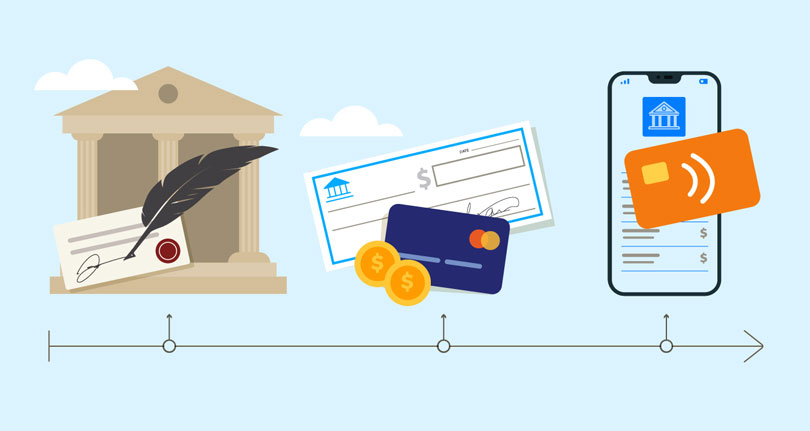
History of banking in America timeline
Early American banking (late 1700s - mid 1800s)
The First Bank of the United States - 1791
After the Revolutionary War, the newly formed United States faced widespread economic disruption, including war debt, an unstable currency, and inflation. Alexander Hamilton, the first Secretary of the Treasury, proposed establishing a national bank to help stabilize the young country's finances and improve the federal government's handling of its financial affairs.
Congress chartered the First Bank of the United States in February 1791 for a term of 20 years. The bank issued currency, made commercial loans, accepted deposits, and acted as a fiscal agent for the U.S. Treasury. It faced opposition from those who believed a national bank exceeded the powers granted to the federal government under the Constitution, as well as from state-chartered banks that viewed it as a competitor. When the bank's charter came up for renewal in 1811, opposition had grown, and Congress allowed the charter to expire. [2] Federal Reserve History, “The First Bank of the U.S.” https://www.federalreservehistory.org/essays/first-bank-of-the-us
The Second Bank of the United States - 1816
Following the War of 1812, many state-chartered banks suspended payments in gold and silver, and the federal government's finances deteriorated. In response, Congress chartered the Second Bank of the United States in 1816, and it opened for business in Philadelphia in January 1817. Like the First Bank, the Second Bank issued currency and acted as a regulator of sorts, holding state banks' notes in reserve and pressing them to redeem those notes in physical coins when it judged they were issuing too much currency. [3] Federal Reserve History, “The Second Bank of the U.S.” https://www.federalreservehistory.org/essays/second-bank-of-the-us
The Second Bank's charter expired in 1836 after President Andrew Jackson vetoed its renewal, arguing the bank concentrated too much financial power in private hands. Its closure left the U.S. without a central banking authority for the next several decades. [4] Minneapolis Fed, “A History of Central Banking” https://www.minneapolisfed.org/about-us/our-history/history-of-central-banking
Free banking - 1837-1863
With no national bank in operation, states passed "free bank laws" allowing new banks to form under lighter regulatory requirements, typically by depositing government bonds with state auditors as collateral for the currency they issued.
Hundreds of new banks opened during this period, roughly 1837 to 1863, and their banknotes circulated across state lines, often trading at a discount depending on the issuing bank's location and perceived reliability. The absence of a uniform national currency and consistent federal oversight contributed to an unstable financial system. [4] Minneapolis Fed, “A History of Central Banking” https://www.minneapolisfed.org/about-us/our-history/history-of-central-banking [5] Philadelphia Fed, “The State and National Banking Eras” https://www.philadelphiafed.org/education/the-state-and-national-banking-eras
The National Banking Act and a uniform currency (1863–1913)
The National Banking Acts of 1863 and 1864
Before the Civil War, the country's currency consisted of coins and notes issued by state-chartered banks. Because banking laws and regulations varied by state, notes issued by a bank in one state were often accepted only at a discount, or not at all, in other states, which made conducting business across state lines difficult.
To help finance the war effort and promote a stable, uniform currency, Congress passed the National Banking Acts of 1863 and 1864. The legislation created a system of federally chartered national banks, established a uniform national currency backed by U.S. government bonds, and imposed a tax on state bank notes to encourage banks to adopt national charters. The acts also established many federal banking regulations that remained in place until, and in some cases after, the Federal Reserve System was created in 1913. [6] Federal Reserve History, “National Banking Acts” https://www.federalreservehistory.org/essays/national-banking-acts
Banking panics of the national banking era - 1863-1913
Despite the reforms of the 1860s, the national banking system remained vulnerable to periodic banking panics between 1863 and 1913. Eight panics struck the financial system centered in New York City during this period, with the panics of 1873, 1893, and 1907 spreading nationwide. [7] Federal Reserve History, “Banking Panics of the Gilded Age” https://www.federalreservehistory.org/essays/banking-panics-of-the-gilded-age
The Panic of 1907 was the most severe of these episodes. It began with a run on trust companies in New York, spread throughout the banking system, and led to a sharp contraction in credit and economic activity nationwide. The panic exposed how little capacity the national banking system had to respond to large-scale withdrawals, since no central authority existed to act as a lender of last resort. [8] Federal Reserve History, “The Panic of 1907” https://www.federalreservehistory.org/essays/panic-of-1907
In response to these banking panics, Congress established the National Monetary Commission in 1908 to study the country's banking problems and recommend reforms. The commission's work laid the groundwork for the Federal Reserve Act of 1913. [9] Minneapolis Fed, “Born of a Panic: Forming the Fed System” https://www.minneapolisfed.org/article/1988/born-of-a-panic-forming-the-fed-system
The Federal Reserve Act - 1913
President Woodrow Wilson signed the Federal Reserve Act into law on December 23, 1913, establishing the Federal Reserve System as the United States' central bank.
The Act created a system with both centralized and regional components: a Federal Reserve Board in Washington, D.C., providing oversight, and 12 regional Federal Reserve Banks, with district boundaries drawn to reflect population and banking activity at the time. The system was responsible for supervising banks, providing a more elastic currency, and acting as a lender of last resort. This meant it could provide emergency short-term loans to commercial banks or financial entities when they could not get funds from elsewhere, and is a structure that remains in place today. [10] Federal Reserve, “Federal Reserve History” https://www.federalreserve.gov/aboutthefed/centennial/about.htm [11] Federal Reserve Education, “Creation of the Federal Reserve” https://www.federalreserveeducation.org/teaching-resources/economics/monetary-policy-the-federal-reserve/creation-of-the-federal-reserve
The Great Depression and new protections - 1930s
Bank failures during the Great Depression - 1929-1933
The stock market crash of 1929 triggered a wave of bank runs, as anxious depositors rushed to withdraw their money in cash. More than 9,000 banks suspended operations between 1929 and 1933, costing depositors an estimated $1.3 billion. By early 1933, bank suspensions and the accompanying panic had grown severe enough that President Franklin Roosevelt declared a nationwide bank holiday, closing all banks on March 6, 1933, just days after he took office. [12] FDIC, “1930-1939” https://www.fdic.gov/history/1930-1939 [13] FDIC, “Fifty First Chapter” https://www.fdic.gov/resources/publications/first-fifty-years/book/first-fifty-chapter1.pdf
Creation of the FDIC - 1933
Congress had considered roughly 150 proposals for a national deposit insurance system between 1886 and 1933, but none had passed. The severity of the banking crisis finally built enough public support for reform. President Roosevelt signed the Banking Act of 1933 (also known as the Glass-Steagall Act) into law that June. This created the Federal Deposit Insurance Corporation (FDIC) to insure bank deposits and restore confidence in the banking system.
A temporary insurance fund took effect in January 1934, initially insuring deposits up to $2,500; the fund became permanent later that year, with coverage raised to $5,000. Congress has since raised the coverage limit numerous times, reaching the current $250,000. [13] FDIC, “Fifty First Chapter” https://www.fdic.gov/resources/publications/first-fifty-years/book/first-fifty-chapter1.pdf [14] Federal Reserve History, “Banking Act of 1933” https://www.federalreservehistory.org/essays/glass-steagall-act
Post-war expansion and consumer banking - 1950s-80s
The introduction of consumer credit - 1950s
Following the end of World War II, consumer credit expanded significantly as banks began offering new products beyond traditional savings and checking accounts. Banks started issuing credit cards in the 1950s, with almost 100 banks offering cards during the decade.
Bank of America launched BankAmericard in California in 1958, and later licensed it to other banks nationwide; it was eventually rebranded as Visa in 1976. A separate network of banks formed the Interbank Card Association in 1966, which became Mastercard. [15] Federal Reserve History, “Electronic Point of Sale Payments” https://www.federalreservehistory.org/essays/electronic-point-of-sale-payments
Deregulation of banking - 1970s-80s
Through the 1970s and 1980s, Congress gradually loosened banking restrictions in place since the Great Depression. President Jimmy Carter signed the Depository Institutions Deregulation and Monetary Control Act into law in March 1980, phasing out interest rate ceilings on deposit accounts, expanding the powers that thrift institutions had, and applying uniform reserve requirements across depository institutions, with rate ceilings set to be fully removed by 1986. [16] Federal Reserve History, “Monetary Control Act of 1980” https://www.federalreservehistory.org/essays/monetary-control-act-of-1980
High interest rates in the early 1980s complicated this phase-out for thrift institutions, so Congress passed the Garn-St. Germain Depository Institutions Act in 1982 to accelerate deregulation, including by creating money market deposit accounts that let institutions pay market rates immediately. These changes contributed to a savings and loan crisis later in the decade, as thrifts took on greater risk under the new rules. [17] Federal Reserve History, “Garn-St Germain Depository Institutions Act of 1982” https://www.federalreservehistory.org/essays/garn-st-germain-act
Modern banking - 1990s-2020s
The beginning of online banking - early 1990s
At the start of the 1990s, many banks had begun offering customers the ability to access their accounts electronically using the internet, in a progression from earlier telephone banking services.
In 1994, the Stanford Federal Credit Union was the first North American financial institution to offer internet banking to all of its customers. The following year, Presidential Bank was the first bank in the U.S. to give online access to customer accounts. [18] Fintech Magazine, “Fintech Timelines and the Story of Online Banking” https://fintechmagazine.com/banking/fintech-timelines-and-the-story-of-online-banking
Bank consolidation and the Gramm-Leach-Bliley Act - 1999
By 1999, the number of U.S. commercial banks had fallen to fewer than 9,000, down from more than 14,000 in 1984, as consolidation continued through the decade.
Congress responded with the Gramm-Leach-Bliley Act, signed into law in November 1999, which repealed large parts of Glass-Steagall's separation of commercial and investment banking and let banks affiliate with securities firms and insurance companies through a new financial holding company structure. [19] Federal Reserve History, “Gramm-Leach-Bliley Act” https://www.federalreservehistory.org/essays/gramm-leach-bliley-act
The financial crisis of 2008
Deteriorating housing and mortgage markets led to the near-collapse of the financial system in September 2008, with major banks, insurers, and government-sponsored enterprises failing or requiring federal support. [20] Federal Reserve History, “The Great Recession and Its Aftermath” https://www.federalreservehistory.org/essays/great-recession-and-its-aftermath
Dodd-Frank Wall Street Reform and Consumer Protection Act - 2010
In response to the 2008 financial crash, President Barack Obama signed the Dodd-Frank Wall Street Reform and Consumer Protection Act into law in July 2010, the most comprehensive financial reform since the Great Depression. It created the Consumer Financial Protection Bureau to consolidate consumer protection authority previously spread across multiple federal agencies, and established the Financial Stability Oversight Council to monitor risk across the financial system. [21] Federal Reserve History, “Dodd-Frank Act” https://www.federalreservehistory.org/essays/dodd-frank-act
The rise of mobile banking - 2010s
As more and more services moved online throughout the 2000s, and smartphones became widespread in the 2010s, banks began offering mobile apps. These gave consumers access to their bank accounts via smartphones, allowing people to check balances and make transfers on the go.
By 2018, 80% of people in the U.S. were using online banking and 51% were using mobile banking on smartphones. [22] CGAA, “When Did Internet Banking Start?” https://www.cgaa.org/article/when-did-internet-banking-start A recent survey on behalf of Self found that mobile banking was the preferred banking method for 52.8% of respondents.
The launch of FedNow - 2023
The Federal Reserve launched the FedNow service in July 2023, introducing an instant payment structure that allowed participating banks and credit unions to send and receive payments in seconds at any time. The U.S. Treasury’s Bureau of the Fiscal Service, along with 35 banks and credit unions, adopted the use of this service at launch. [23] Federal Reserve, “FedNow Service” https://www.federalreserve.gov/newsevents/pressreleases/other20230720a.htm
The future of banking
Open banking
Open banking lets you securely share your financial data across banks and third-party financial apps through standardized technology. Financial institutions are increasingly building the infrastructure needed to support features such as pay-by-bank, which lets you pay directly from your bank account rather than through a card network. [24] JP Morgan, “Where Open Banking Goes Next” https://www.jpmorgan.com/payments/payments-unbound/magazine/articles/open-banking-internet-of-money
AI in banking
Banks have increasingly adopted artificial intelligence for functions such as fraud detection, cybersecurity, and customer service, and regulators have updated their oversight accordingly. In April 2026, the Federal Reserve, OCC, and FDIC jointly revised their model risk management guidance, first issued in 2011, taking a more flexible, principles-based approach while excluding generative and agentic artificial intelligence (AI) from its scope given how novel these technologies remain. [25] Federal Reserve, “Supervisory Letter SR 26-2 on Revised Guidance on Model Risk Management” https://www.federalreserve.gov/supervisionreg/srletters/SR2602.htm
Regulators have also flagged AI-specific risks. The OCC's spring 2026 risk report found that AI is reshaping the cybersecurity threat landscape for banks, making attacks easier to launch and enabling faster, more sophisticated intrusions. [26] OCC, “Semiannual Risk Perspective Spring 2026” https://www.occ.gov/publications-and-resources/publications/semiannual-risk-perspective/files/semiannual-risk-perspective-spring-2026.html
In February 2026, the U.S. Department of the Treasury released an AI lexicon and risk management framework for financial institutions, aimed at standardizing terminology and supporting safe AI adoption across the industry. [27] U.S. Treasury, “Treasury Releases Two New Resources to Guide AI Use in the Financial Sector” https://home.treasury.gov/news/press-releases/sb0401
Sources
- [1] FDIC, “Find Insured Banks” https://banks.data.fdic.gov/bankfind-suite/bankfind
- [2] Federal Reserve History, “The First Bank of the U.S.” https://www.federalreservehistory.org/essays/first-bank-of-the-us
- [3] Federal Reserve History, “The Second Bank of the U.S.” https://www.federalreservehistory.org/essays/second-bank-of-the-us
- [4] Minneapolis Fed, “A History of Central Banking” https://www.minneapolisfed.org/about-us/our-history/history-of-central-banking
- [5] Philadelphia Fed, “The State and National Banking Eras” https://www.philadelphiafed.org/education/the-state-and-national-banking-eras
- [6] Federal Reserve History, “National Banking Acts” https://www.federalreservehistory.org/essays/national-banking-acts
- [7] Federal Reserve History, “Banking Panics of the Gilded Age” https://www.federalreservehistory.org/essays/banking-panics-of-the-gilded-age
- [8] Federal Reserve History, “The Panic of 1907” https://www.federalreservehistory.org/essays/panic-of-1907
- [9] Minneapolis Fed, “Born of a Panic: Forming the Fed System” https://www.minneapolisfed.org/article/1988/born-of-a-panic-forming-the-fed-system
- [10] Federal Reserve, “Federal Reserve History” https://www.federalreserve.gov/aboutthefed/centennial/about.htm
- [11] Federal Reserve Education, “Creation of the Federal Reserve” https://www.federalreserveeducation.org/teaching-resources/economics/monetary-policy-the-federal-reserve/creation-of-the-federal-reserve
- [12] FDIC, “1930-1939” https://www.fdic.gov/history/1930-1939
- [13] FDIC, “Fifty First Chapter” https://www.fdic.gov/resources/publications/first-fifty-years/book/first-fifty-chapter1.pdf
- [14] Federal Reserve History, “Banking Act of 1933” https://www.federalreservehistory.org/essays/glass-steagall-act
- [15] Federal Reserve History, “Electronic Point of Sale Payments” https://www.federalreservehistory.org/essays/electronic-point-of-sale-payments
- [16] Federal Reserve History, “Monetary Control Act of 1980” https://www.federalreservehistory.org/essays/monetary-control-act-of-1980
- [17] Federal Reserve History, “Garn-St Germain Depository Institutions Act of 1982” https://www.federalreservehistory.org/essays/garn-st-germain-act
- [18] Fintech Magazine, “Fintech Timelines and the Story of Online Banking” https://fintechmagazine.com/banking/fintech-timelines-and-the-story-of-online-banking
- [19] Federal Reserve History, “Gramm-Leach-Bliley Act” https://www.federalreservehistory.org/essays/gramm-leach-bliley-act
- [20] Federal Reserve History, “The Great Recession and Its Aftermath” https://www.federalreservehistory.org/essays/great-recession-and-its-aftermath
- [21] Federal Reserve History, “Dodd-Frank Act” https://www.federalreservehistory.org/essays/dodd-frank-act
- [22] CGAA, “When Did Internet Banking Start?” https://www.cgaa.org/article/when-did-internet-banking-start
- [23] Federal Reserve, “FedNow Service” https://www.federalreserve.gov/newsevents/pressreleases/other20230720a.htm
- [24] JP Morgan, “Where Open Banking Goes Next” https://www.jpmorgan.com/payments/payments-unbound/magazine/articles/open-banking-internet-of-money
- [25] Federal Reserve, “Supervisory Letter SR 26-2 on Revised Guidance on Model Risk Management” https://www.federalreserve.gov/supervisionreg/srletters/SR2602.htm
- [26] OCC, “Semiannual Risk Perspective Spring 2026” https://www.occ.gov/publications-and-resources/publications/semiannual-risk-perspective/files/semiannual-risk-perspective-spring-2026.html
- [27] U.S. Treasury, “Treasury Releases Two New Resources to Guide AI Use in the Financial Sector” https://home.treasury.gov/news/press-releases/sb0401
Becca Bennett
Becca has over 10 years of experience as a content writer, working across various industries including finance, digital marketing, education, travel, and technology. Her work has been featured in publications including Forbes, Business Insider, AOL, Yahoo, GOBankingRates, and more.


 Money