History of Credit Cards in the U.S.
Credit cards have become a central part of consumer finance in the U.S; as of 2025,
around 90% of American consumers have at least one credit card, with an average of 3.7 active cards per person.
[1] Experian, “What is the Average Number of Credit Cards?” https://www.experian.com/blogs/ask-experian/average-number-of-credit-cards-a-person-has/
In this article, we’ll explore the history of credit cards in the U.S., from the
first iterations to the modern credit cards many of us use today.
Key points
- Credit cards have been in use for over 130 years, evolving from
merchant charge coins in the late 1800s to the multipurpose digital payment methods used
today.
- The BankAmericard, launched in 1958, was the first
general-purpose credit card to offer revolving credit, allowing users to carry a balance and
pay it down in installments.
- Federal consumer protection laws introduced between 1968 and
2009, including the Truth in Lending Act and the Credit CARD Act, established standardized
disclosures, billing dispute rights, and limits on fees and interest rate increases.
- EMV chip technology, introduced in 1994, uses
encryption and tokenization to protect credit card data during transactions.
- Mobile wallets such as Google Wallet and Apple Pay, launched in
the 2010s, use Near Field Communication (NFC) technology to allow consumers to make
contactless payments via smartphone.
History of credit cards timeline
Early credit: Before credit cards
Late 1800s - Charge Coins
One of the very first forms of credit was charge coins, first issued in 1890. These
coins were issued by stores to allow certain customers to make multiple purchases on a tab and pay them off
later. The coins were unique to each customer and bore a customer number.
When making a purchase, the salesperson would check that the customer’s name matched
the number on the coin before the customer could receive their purchase. [2] Credit Collectibles, “The Evolution of Charge Coins to Credit Cards” https://www.creditcollectibles.com/evolution-of-charge-coins-to-credit-cards/
1920s - Charga-Plates
In 1928, the Charga-Plate was introduced as a method for customers to make payments
on their accounts at a specific store. These plates resembled military dog tags, with the front containing the
owner’s name, address, and account number. Metal plates like these were used until the 1950s, allowing customers
to purchase goods from a specific store and pay for them later. [2] Credit Collectibles, “The Evolution of Charge Coins to Credit Cards” https://www.creditcollectibles.com/evolution-of-charge-coins-to-credit-cards/ [3] American History, “Plastic Payments” https://americanhistory.si.edu/explore/exhibitions/value-money/online/innovations-money/plastic-payments
When were credit cards invented?
1950 - The Diners Club
Frank McNamara launched the world’s first widely recognized multipurpose charge card
after he forgot his wallet at a restaurant in New York in 1949. Frank and his lawyer returned to the same
restaurant in February 1950 and paid their bill using a cardboard prototype card, now known as the Diners Club
Card.
The card was initially designed as a charge card for New York’s business elite and
grew to 10,000 members in its first year, and 28 restaurants and two hotels agreed to accept monthly billing for
select clientele through these cards.
In the 1960s, the cardboard Diners Club Card turned plastic, and in the 1970s, the
company introduced its first range of corporate cards. [4] Diners Club US, “Company History of Diners Club” https://www.dinersclubus.com/home/about/dinersclub/story
1958 - BankAmericard
Bank of America launched the BankAmericard in 1958 as the first general-purpose
credit card. This meant that the card could be used across different retailers and purposes, unlike previous
iterations that were linked to particular retailers, or the Diners Club Card, which was mostly used in
restaurants.
The BankAmericard was also the first card to offer revolving credit, meaning the
user could pay it down in installments rather than pay the entire balance at the end of the month.
Bank of America started licensing the card to other banks, and BankAmericard
eventually spun off into its own company in 1970. Later, in 1976, the BankAmericard was officially rebranded as
the Visa Card. [5] American History, “First & Merchants Bank Americard Visa” https://americanhistory.si.edu/collections/object/nmah_1444151 [6] Federal Reserve History, “Electronic Point of Sale Payments” https://www.federalreservehistory.org/essays/electronic-point-of-sale-payments
Early credit card technology
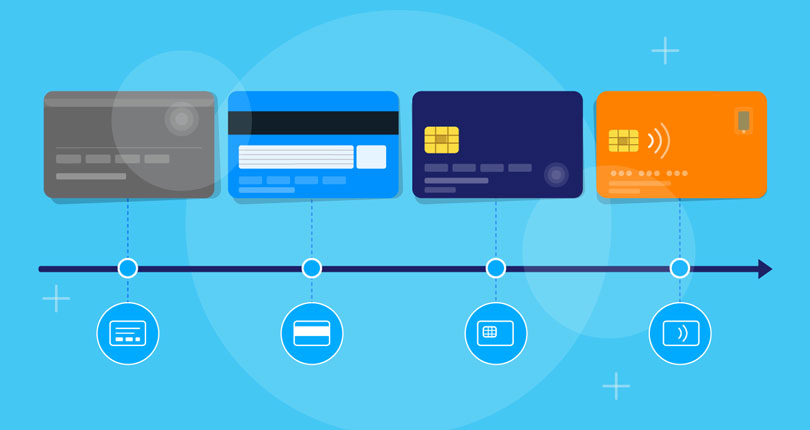
Early 1960s - Magnetic Stripe
The magnetic stripe is a technology most of us carry on credit cards, loyalty cards,
and driver’s licenses. This thin strip of magnetic material contains information that can be accessed when it is
swiped through a reader.
Magnetic stripes were developed by engineer Forrest Parry from IBM; he wanted to
develop a magnetic strip of tape to attach to CIA identity cards to make them more secure. By 1969, the mag
stripe technology had been adopted as a U.S. standard and, two years later, as an international standard.
Combined with point-of-sale devices, computers, and data networks, the magnetic stripe sparked what would soon
become the global credit card industry. [7] IBM, “The Magnetic Stripe” https://www.ibm.com/history/magnetic-stripe
Credit card legislation and consumer protections
1968 - Truth in Lending Act
With credit card use becoming more popular among American consumers, the government
introduced the Truth in Lending Act (TILA) in 1968. This required creditors to disclose standardized information
and offered additional consumer protections for a number of financing products.
TILA was enacted as part of the Consumer Credit Protection Act. It applies to
“open-end credit”, such as credit cards, with repeat transactions and unspecified end dates for repayment, and
“closed-end credit” with set terms and repayment structures, like auto loans.
Under TILA, creditors must include disclosures at origination, periodic statements,
and application disclosures for some products. The specific disclosure requirements may vary depending on the
type of credit. [8] Congress, “Overview of the Truth in Lending Act” https://www.congress.gov/crs-product/IF12769
1974 - Fair Credit Billing Act
The Fair Credit Billing Act of 1974 gave consumers the right to dispute billing
errors and requires prompt written acknowledgment of consumer billing complaints. It also requires creditors to
investigate billing errors and prohibits them from taking any action that adversely affects the consumer’s
credit until the investigation is complete. [9] FTC, “Fair Credit Billing Act” https://www.ftc.gov/legal-library/browse/statutes/fair-credit-billing-act
1988 - Fair Credit and Charge Card Disclosure Act
Introduced in 1988, the Fair Credit and Charge Card Disclosure Act brought in new
requirements for creditors to disclose information related to charge card and credit card account applications
and solicitations. This included separate disclosure requirements for credit card applications and solicitations
by mail, telephone, and other means.
This amendment requires credit card solicitors to disclose, among other things,
information about annual percentage rates, annual and other fees, minimum finance charges, grace periods, and
balance calculation methods. [10] Congress, “Fair Credit and Charge Card Disclosure Act of 1988” https://www.congress.gov/bill/100th-congress/house-bill/515
Credit card chips and contactless payments
1994 - EMV Chips
EMV, which stands for Europay, Mastercard, and Visa, is a type of chip developed by
these three credit card companies to make credit card payments more secure.
The first version of EMV chip cards came out in 1994. They use encryption and
tokenization to add layers of security to payment cards. Encryption scrambles your data in transit, and
tokenization generates a virtual token that allows merchants to collect your data without sharing your actual
credit card details. [11] Credit One Bank, “How Does an EMV Chip Card Protect You?” https://www.creditonebank.com/articles/see-how-an-emv-chip-card-protects-you
1995 - First contactless payments
The world’s first contactless payment card, the UPass, was launched in Korea by the
Seoul Bus Transport Association, allowing commuters to pay for their journeys with contactless technology, and
this went on to spark the introduction of contactless payments around the world. [12] Global Payments Integrated, “The History of Contactless Payments” https://www.globalpaymentsintegrated.com/en-us/blog/2020/09/15/the-history-of-contactless-payments
Mid-2000s - Contactless cards launch in the U.S.
Contactless payment cards were first used in the U.S. in 2004, and in 2008, Visa,
Mastercard, and American Express began offering contactless credit cards. [12] Global Payments Integrated, “The History of Contactless Payments” https://www.globalpaymentsintegrated.com/en-us/blog/2020/09/15/the-history-of-contactless-payments
Landmark consumer protection law
2009 - The Credit CARD Act
Congress passed the CARD Act in 2009 as a way to “establish fair and transparent
practices related to the extension of credit”. The Act contains a range of consumer protections, many of which
relate to interest rates, disclosures, fees, and marketing to young adults.
Some of the key protections include:
- Credit card issuers can only charge interest on balances from the current billing cycle. Formerly, they
could charge interest based on the average daily balance from the previous two billing cycles, even if the
previous month’s balance had been paid off.
- Limitations on when card issuers can raise interest - credit card issuers cannot raise your interest during
the first 12 months you have the card. They must give at least 45 days' notice before increasing interest
rates, and there must be a valid reason for the increase.
- Fewer fees and caps on fees: This includes a fee limit during the first year, caps on late and over-limit
fees, and no pay-to-pay or inactivity fees.
- You have at least 21 days to pay your bill - card issuers must deliver your bill a minimum of 21 days before
the bill is due, and if a grace period is offered, it must be at least 21 days long.
[13] Experian, “What is the Credit CARD Act of 2009?” https://www.experian.com/blogs/ask-experian/what-is-the-credit-card-act-of-2009/
Mobile wallets
2010s
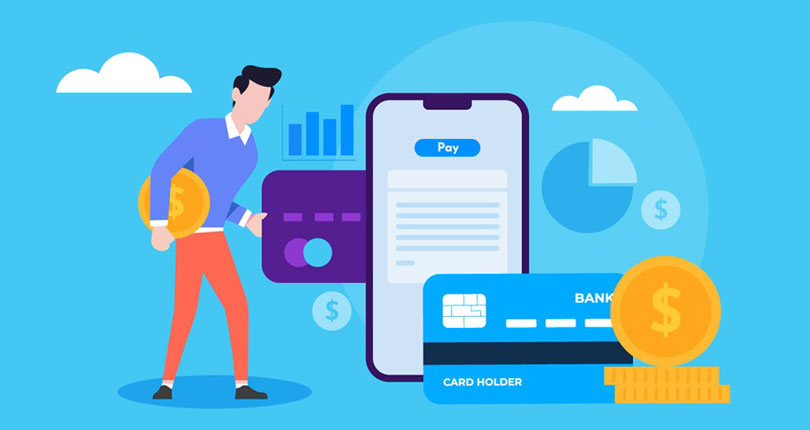
In 2011, Google WalletTM and Android PayTM were launched, giving consumers the
option to make contactless debit and credit card payments using their smartphones instead of physical cards. A
few years later, in 2014, Apple Pay® was launched for iPhone users. [12] Global Payments Integrated, “The History of Contactless Payments” https://www.globalpaymentsintegrated.com/en-us/blog/2020/09/15/the-history-of-contactless-payments
These mobile payment methods are powered by Near Field Communication (NFC), which
was first introduced in the early 2000s, and is the same technology used in contactless cards.
NFC is a type of radio-frequency identification (RFID) that allows us to identify
things through radio waves. When a payment is initiated through a smartphone wallet like Google WalletTM or
Apple Pay® , the customer’s phone must be within two inches of the point-of-sale system to complete the payment.
Information is transmitted via radio frequency to process the payment within a few seconds.
[14] Square Up, “What is NFC? A Complete Guide to Near Field Communication” https://squareup.com/us/en/the-bottom-line/managing-your-finances/nfc
The future of credit cards
Advances in artificial intelligence (AI) and technology are beginning to shape how
consumers interact with credit card products. The CFPB's 2025 Consumer Credit Card Market Report identifies
several developments that could influence the market going forward.
On the consumer side, AI-powered tools are being used to help cardholders manage
debt, including assistance with structuring repayment plans. Issuers are also drawing on alternative data
sources, such as bank account cash flow data, to extend credit card access to consumers with limited credit
histories.
However, the same technology is also being used to facilitate fraud, with the CFPB
noting that AI is increasing both the frequency and severity of payments-related fraud. Beyond AI, the report
identifies alternative payment methods, including stablecoins and pay-by-bank, as emerging developments that
could affect how credit cards compete in the broader payments market. [15] Consumer Finance, “The Consumer Credit Card Market Report” https://files.consumerfinance.gov/f/documents/cfpb_consumer-credit-card-market-report_2025.pdf
Sources
- [1] Experian, “What is the Average Number of Credit Cards?” https://www.experian.com/blogs/ask-experian/average-number-of-credit-cards-a-person-has/
- [2] Credit Collectibles, “The Evolution of Charge Coins to Credit Cards” https://www.creditcollectibles.com/evolution-of-charge-coins-to-credit-cards/
- [3] American History, “Plastic Payments” https://americanhistory.si.edu/explore/exhibitions/value-money/online/innovations-money/plastic-payments
- [4] Diners Club US, “Company History of Diners Club” https://www.dinersclubus.com/home/about/dinersclub/story
- [5] American History, “First & Merchants Bank Americard Visa” https://americanhistory.si.edu/collections/object/nmah_1444151
- [6] Federal Reserve History, “Electronic Point of Sale Payments” https://www.federalreservehistory.org/essays/electronic-point-of-sale-payments
- [7] IBM, “The Magnetic Stripe” https://www.ibm.com/history/magnetic-stripe
- [8] Congress, “Overview of the Truth in Lending Act” https://www.congress.gov/crs-product/IF12769
- [9] FTC, “Fair Credit Billing Act” https://www.ftc.gov/legal-library/browse/statutes/fair-credit-billing-act
- [10] Congress, “Fair Credit and Charge Card Disclosure Act of 1988” https://www.congress.gov/bill/100th-congress/house-bill/515
- [11] Credit One Bank, “How Does an EMV Chip Card Protect You?” https://www.creditonebank.com/articles/see-how-an-emv-chip-card-protects-you
- [12] Global Payments Integrated, “The History of Contactless Payments” https://www.globalpaymentsintegrated.com/en-us/blog/2020/09/15/the-history-of-contactless-payments
- [13] Experian, “What is the Credit CARD Act of 2009?” https://www.experian.com/blogs/ask-experian/what-is-the-credit-card-act-of-2009/
- [14] Square Up, “What is NFC? A Complete Guide to Near Field Communication” https://squareup.com/us/en/the-bottom-line/managing-your-finances/nfc
- [15] Consumer Finance, “The Consumer Credit Card Market Report” https://files.consumerfinance.gov/f/documents/cfpb_consumer-credit-card-market-report_2025.pdf


 Money
Money