Back to articles
How Long Does a Repossession Stay on Your Credit Report?
Your credit report includes more than just records of your payment history; it also includes things like repossessions and foreclosures. “Repossession” refers to property that is seized (rightfully and lawfully) to repay the debt owed.
Repossessions can occur as a result of failure to pay back a loan. When you take out a loan to buy something, the thing you’re buying acts as collateral to ensure you make your loan payments.
For example, when you take out a car loan, the vehicle serves as collateral for the loan. Depending on state law, the lender's name may remain as the lienholder on the title until you pay off the loan balance.[1]
According to the Federal Trade Commission, if you stop making loan payments, the lender typically has the right to repossess the vehicle without going to court or warning you in advance. [2]
Records of major events like a car repossession can be extremely damaging to your credit, and not just in the short term. In fact, accurate negative marks can remain on your credit reports for up to seven years, including repossessions.
You should be aware that there are two kinds of repossessions: voluntary (also known as surrenders) and involuntary. A voluntary repossession allows you to avoid the stress that comes with waiting for a third party to seize your vehicle. It might also help you avoid some of the fees that come with an involuntary repossession. Though a voluntary repossession will still have a negative impact on your credit score, some lenders might see them more favourably as you’ve been willing to work with your past lenders to manage a default. [3]
Key points
- Repossessions remain on credit reports for seven years from the original delinquency date—the date you first missed a payment before the repossession occurred.
- Rebuilding credit after repossession requires habits like, paying down debt, limiting new credit applications, and making consistent on-time payments, as payment history accounts for 35% of your FICO score. [4]
How long does a repossession stay on your credit report?
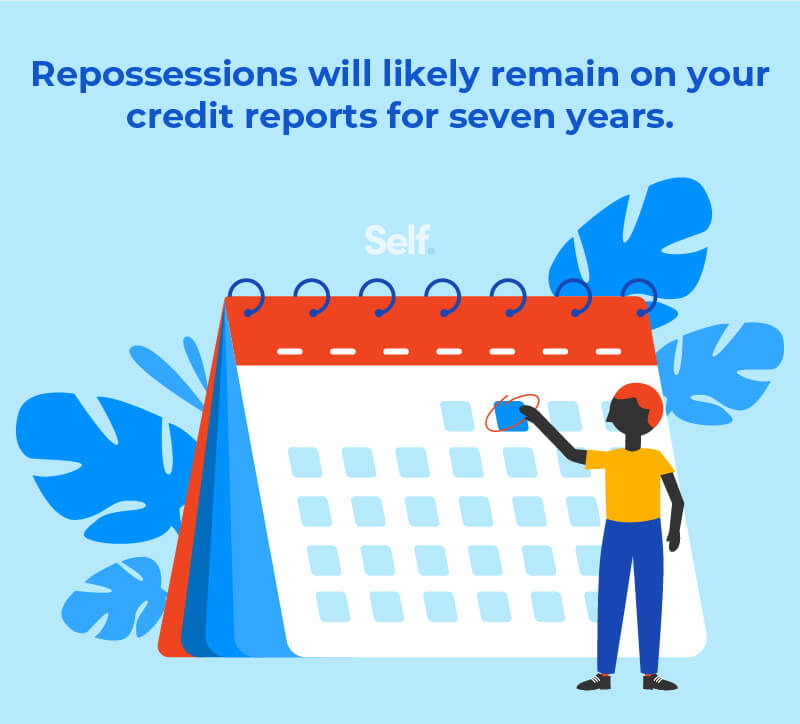
A repossession will stay on your credit report for seven years from the date of the original delinquency—the date you first missed a payment before the repossession occurred. [5]
Can a repossession be removed from your credit report?
You may be wondering, “Can I remove a repossession from my credit report?” Unfortunately, the answer is no, not if it’s accurate. Accurate information reported on your credit report cannot be removed.[6] Errors, however, can and should be addressed, and you can get them removed by disputing them.
To see if there are any errors in your report, obtain a copy of your credit report from the three main credit bureaus (Equifax, Experian and TransUnion). You can access a free credit report once a week at annualcreditreport.com.
Once you’ve got your report, look through it for anything that doesn’t seem right. Unfortunately, reporting errors happen. In fact, one study by Consumer Reports revealed that 44% of people found at least one mistake on their credit reports. [7] These errors can range from incorrect payment dates to duplicate entries, from transposed numbers to identity theft.
If you find that something on your credit report is inaccurate or a mistake, you can dispute it. If you're successful, the negative information will be removed.
How does a repossession affect your credit score?
A variety of factors go into your credit score. First, two major credit-scoring entities are VantageScore and the more widely used FICO® (short for Fair Isaac Corporation), which produces the FICO score.
FICO scores range from 300 to 850 and are divided into five categories: exceptional (800-850), very good (740-799), good (670-739), fair (580-699), and very poor (300-579). To calculate your score, FICO considers five different weighted factors, the most important of which is your payment history, which constitutes 35% of your score. [4]
As a result, late payments tend to hurt your credit score more than anything else. And since a repossession only occurs after multiple missed payments, it can be particularly damaging to your credit score.
On top of having a repossession marked on your credit report, the following would likely contribute to negative marks:
Late payments
- Every missed payment (30 days late) results in a negative mark on your credit report, which reflects poorly on your score.
- The impact on your credit score can increase the longer that the payment is late.
- Additional late payments can lead to an ever greater impact on your credit score. [8]
Delinquencies
- An account remains delinquent until you pay the overdue amount plus any associated fees. After several months of missed payments, the account may go into default. Delinquent accounts are less severe than accounts in default. In most cases, delinquencies can be solved by paying the overdue amount along with any fees or charges associated with them. Your normal payments can continue straight away afterwards.[9]
Defaults
- A default occurs when you fail to make loan payments for an extended period, typically after several months of delinquency.
- Unlike a delinquency, defaults usually trigger the remainder of your loan balance to be due in full, and your usual installment payments will end.
- Because defaults are more seriously past due, they will more negatively impact your credit history. [9] [10]
Collections
- Collection accounts are reported by lenders who transfer your account to a collection agency or debt buyer if you have fallen behind on payments. This will typically occur a few months after you have become delinquent. The lender writes the debt off as a loss (called a charge-off). Still, it doesn’t disappear: You now owe the collection agency instead of the original creditor.
- Some credit scoring models might ignore debt collections relating to smaller debts (for example, less than $100). Certain types of debt may also be treated differently by some credit scoring models, like medical debt for instance. [11]
Recent credit reporting information is weighed more than older credit history. So whether you're paying student loans, personal loans, or auto loans, paying on time is the way to go.
The good news is that the longer in the past the repossession happened, the less it should weigh down your credit score. Assuming you continue to use credit responsibly, the positive information can outweigh the negative over time.
How can you rebuild your credit after a repossession?
Even after a repo, you can still rebuild or repair your credit. There’s a difference between these two processes that’s worth noting. Credit repair is the process used to remove inaccurate information from your credit report. On the other hand, rebuilding your credit involves doing what's necessary going forward to improve your credit score. You can build credit by:
- Checking your credit. Do so regularly to ensure you’re up to date on payments and to guard against errors. You can also track your progress by getting a free credit score from FICO.
- Making on-time payments. Because on-time payments account for the highest percentage (35%) of your FICO score, this is the most proactive step you can take to get results. [4]
- Paying down debt. Paying down your debt helps lower your credit utilization ratio (the amount of debt you’re carrying compared to your credit limit). Because the amount of debt you have accounts for 30% of your credit score, paying off debt can help you build your credit. [4]
- Consider a credit builder loan. A type of loan held in a bank-held Certificate of Deposit (CD) that you pay off in monthly installments. Your payments are reported to the credit bureaus, and you receive the loan amount once you have completed all of the payments.
- Try a secured credit card. You open the card with a security deposit, which typically becomes your credit limit. Use the card to make purchases, and your on-time payments will be reported to the credit bureaus.
- Rent and bills reporting. You can report your on-time rent and utility bill payments to the credit bureaus to help build your credit score.
It's also a good idea to avoid the temptation to apply for new credit. Every time you apply for new credit, a hard inquiry is added to your credit report. A hard inquiry is when a lender looks at your credit report to determine whether to grant you a loan. Each hard inquiry can shave a few points off your credit score.
The bottom line
Auto lenders don’t want to repossess your car; they’d rather get paid, so they only repossess as a last resort.
A repossession can hurt your credit history. After repossession, you'll probably have a hard time getting a loan or credit card. However, if you're successful, you may face higher interest rates. [12]
In the meantime, the best thing you can do is look to the future. Get your personal finances back in order by building your credit through on-time payments, low credit card balances, selective applications, and diligence at tracking your credit. It won’t happen overnight, but you can build your credit again, so it will be there when you need it.
Sources
- Car and Driver, “When Financing a Car, Who Has the Title?” https://www.caranddriver.com/research/a32780457/when-financing-a-car-who-has-the-title/ Accessed February 3, 2026
- FTC, “Vehicle Repossession” https://consumer.ftc.gov/articles/vehicle-repossession Accessed February 3, 2026
- Equifax, “What is Repossession?” https://www.equifax.com/personal/education/personal-finance/articles/-/learn/what-is-reposession/ Accessed February 26, 2026
- MyFICO, “How Are FICO Scores Calculated?” https://www.myfico.com/credit-education/whats-in-your-credit-score Accessed February 3, 2026
- American Express, “How Long Does a Repo Stay on Your Credit?” https://www.americanexpress.com/en-us/credit-cards/credit-intel/how-long-does-a-repo-stay-on-your-credit/ Accessed February 3, 2026
- Experian, “Can I Remove Negative Accurate Information From My Credit Report?” https://www.experian.com/blogs/ask-experian/can-remove-negative-accurate-information-credit-report/ Accessed February 3, 2026
- Advocacy, “Almost Half of Participants in Credit Checkup Study Find Errors on Credit Reports” https://advocacy.consumerreports.org/press_release/almost-half-of-participants-in-credit-checkup-study-find-errors-on-credit-reports-more-than-a-quarter-find-serious-mistakes/ Accessed February 3, 2026
- Experian, “When Do Late Payments Get Reported?” https://www.experian.com/blogs/ask-experian/when-do-late-payments-get-reported/ Accessed February 3, 2026
- Investopedia “Loan Delinquency Vs Defaults” https://www.investopedia.com/ask/answers/062315/what-are-differences-between-delinquency-and-default.asp Accessed February 3, 2026
- Experian, “Will a Default Be Removed if Paid?”https://www.experian.com/blogs/ask-experian/will-a-default-be-removed-if-paid/ Accessed February 3, 2026
- Equifax, “Collection Accounts” https://www.equifax.com/personal/education/credit/report/articles/-/learn/collection-accounts/ Accessed February 3, 2026
- Lending Tree, “How Bad Does a Car Repossession Affect Your Credit?” https://www.lendingtree.com/credit-repair/how-a-car-repossession-affects-your-credit/ Accessed February 26, 2026
Editorial Policy
Our goal at Self is to provide readers with current and unbiased information on credit, financial health, and related topics. This content is based on research and other related articles from trusted sources. All content at Self is written by experienced contributors in the finance industry and reviewed by an accredited person(s).