Back to articles
What Is a Credit Privacy Number (CPN) and Is It Legal?
A credit privacy number (CPN) is often marketed as a way to hide bad credit or start fresh, but using one can carry serious legal risks. While some websites claim a CPN functions like a second Social Security number, numbers sold for this purpose are frequently misrepresented and may involve identity misuse.[1]
Before considering a CPN, it’s important to understand what the term actually means, whether it is legal, and what safer alternatives exist for rebuilding credit. Below, we explain how CPNs are commonly marketed, why they raise red flags, and what legitimate options you have instead.
Key points
- A credit privacy number (CPN) is a nine-digit number that resembles a Social Security number and is often marketed as a way to apply for credit without using your SSN.
- CPNs are not recognized as a legal substitute for a Social Security number, and using a purchased or misrepresented number on a credit application can constitute fraud or identity theft.
- Companies that sell CPNs frequently promote them as a way to bypass credit checks or erase bad credit, but accurate negative information cannot be legally removed from your credit report simply by using a different number.
What is a credit privacy number and what is it used for?
A credit privacy number (CPN) is a nine-digit number that looks just like a Social Security number. That’s no coincidence because illegitimate CPNs are actually stolen Social Security numbers.
However, there are also legitimate and legal CPN numbers, which you’ll learn about later in this article.
Some people refer to a CPN number as a “credit privacy number,” while others call it a “credit protection number” or “credit profile number”.
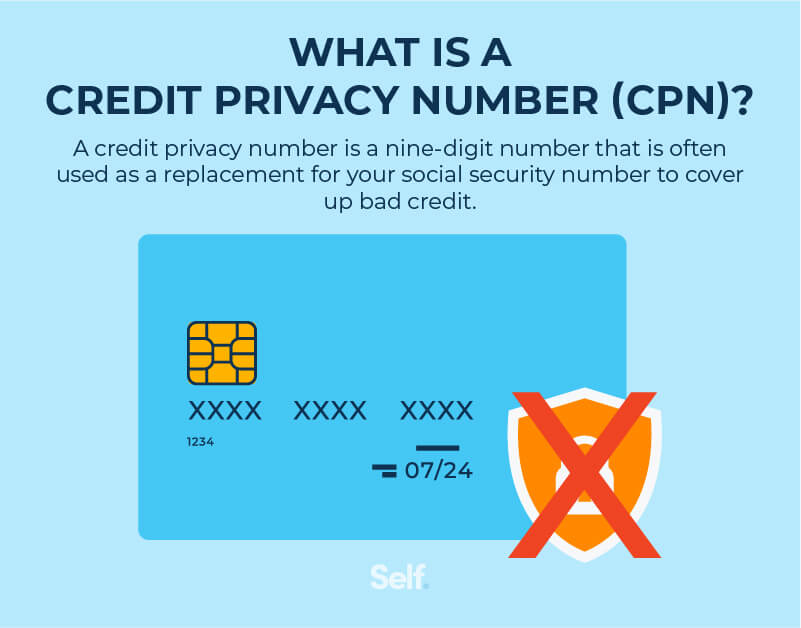
By any name, a CPN is something to be wary of — especially if someone’s trying to sell you one. Some companies will charge for a CPN.[1]
Scammers will describe CPNs as a second version of a Social Security number that supposedly adds extra security. They’ll tout them as a way to clean up your credit quickly.
Are CPNs illegal?
A credit privacy number is not inherently illegal, but likely not legitimate and using one to misrepresent your identity or credit history is against the law. CPNs are often marketed as a way to bypass credit checks or hide poor credit, and using them this way may involve identity theft or fraud. Federal agencies warn that applying for credit with information that does not belong to you — including a misrepresented or purchased CPN — can result in criminal charges.[1]
How to avoid CPN scams
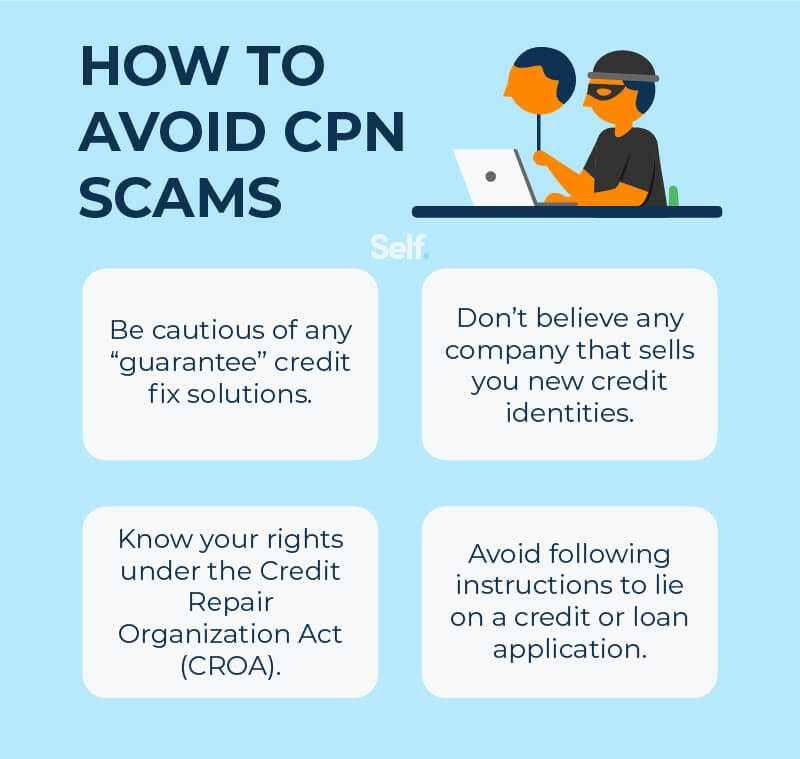
Be careful about dealing with any company that promises a new credit identity. If they tell you a CPN is a substitute for a Social Security number, don’t believe them, and if they try to sell you a CPN, remember that legal CPNs aren’t for sale.
Similarly, don’t believe any company that asks you to apply for an employer identification number. EINs are legal, but businesses use them when reporting to the IRS, and they’re not a substitute for Social Security numbers.[3] Scammers, however, will try to tell you that they are.
Legitimate ways to rebuild credit
While you may not be able to help boost your credit score overnight, you can always take steps towards rebuilding it.
Reach out to a credit counselor
Credit counselors are available to help you build your credit. Credit counseling services can help you with things like budgeting, creating a plan to pay down debt including a debt management plan, dealing with debt collectors, repaying student loans, and other ways to start or continue building good credit.
The National Foundation for Credit Counseling, or NFCC, is a national network of nonprofit credit counseling agencies that can help you find an accredited counselor to work with.[4] Credit counselors are different from credit repair companies, which offer to help you repair your credit for a fee.
Some credit repair companies will try to get errors removed from your credit reports by disputing inaccurate information. However, you can learn how to fix your credit report errors without paying someone else.
Be aware that no credit repair company can get negative marks removed from your credit file if they’re accurate.
Pay all your bills and loans on time
The most important thing you can do to improve your credit is to make your payments on time, such as your credit card bills, loans, and utility payments. Your payment history affects your FICO® credit score more than any other single factor, accounting for 35% of the total. [5]
Payments that are more than 30 days late get reported to the three major credit bureaus and stay on your credit report for up to seven years. But keeping up with your payments consistently can build your credit, especially over time, because the length of your credit history also affects your credit score.
If you’re looking to rebuild your credit, a secured credit card can be an option worth exploring. You secure your card with a deposit (usually a few hundred dollars) in a linked savings account or certificate of deposit. As you make payments on time, your credit score could improve over time. See more about using secured credit cards to rebuild credit.
Keep your credit utilization low
Your credit utilization ratio is the amount of debt you have on all your credit cards divided by your total credit limit. If you have a credit limit of $5,400 on four credit cards, for example, and owe a total of $1,200 on all four, your credit utilization ratio is 22.2%.
Experts advise borrowers to keep their credit utilization ratio below 30%, with the best credit scores typically going to those with a ratio of 10% or less.[6]
What to do instead of using a CPN
Obtaining a CPN is not a legal way to get rid of poor credit. If someone’s trying to sell you one, it’s best to steer clear.
Instead of looking for a quick fix, pursue legitimate ways of building your credit, such as making your payments on time, reducing the amount of debt you're carrying, and consulting a credit counselor to develop an effective, long-term strategy.
Sources
- TransUnion. “What Is a Credit Privacy Number (CPN)?,” https://www.transunion.com/article/what-is-a-cpn. Accessed on February 10, 2026.
- Federal Reserve Bank of St. Louis. “The Old, the Young and the Incarcerated: Latest ID Theft Victims,” https://www.stlouisfed.org/publications/bridges/winter-20102011/the-old-the-young-and-the-incarcerated-latest-id-theft-victims. Accessed February 11, 2026.
- Federal Trade Commission Consumer Information. “Credit Repair Scams,” https://www.consumer.ftc.gov/articles/0225-credit-repair-scams. Accessed February 11, 2026.
- NFCC. “A trusted non-profit organization to help manage your finances,” https://www.nfcc.org/about-us/. Accessed September 10, 2021.
- myFICO. “What’s in Your FICO® Scores?” https://www.myfico.com/credit-education/whats-in-your-credit-score. Accessed February 11, 2026.
- CNBC. “Does a $0 balance on your credit card make your score go up?” https://www.cnbc.com/select/what-is-a-good-credit-utilization-ratio/. Accessed February 11, 2026.
About the reviewer
Ana Gonzalez Ribeiro, MBA, AFC® is an Accredited Financial Counselor® and a Bilingual Personal Finance Writer and Educator dedicated to helping populations that need financial literacy and counseling. Her informative articles have been published in various news outlets and websites including Huffington Post, Fidelity, Fox Business News, MSN and Yahoo Finance. She also founded the personal financial and motivational site www.AcetheJourney.com and translated into Spanish the book, Financial Advice for Blue Collar America by Kathryn B. Hauer, CFP. Ana teaches Spanish or English personal finance courses on behalf of the W!SE (Working In Support of Education) program has taught workshops for nonprofits in NYC.
About the author
Becca has over 10 years of experience as a content writer, working across various industries including finance, digital marketing, education, travel, and technology. Her work has been featured in publications including Forbes, Business Insider, AOL, Yahoo, GOBankingRates, and more.