Money
Money The Cost of Convenience: How much extra are Americans spending on grocery delivery?
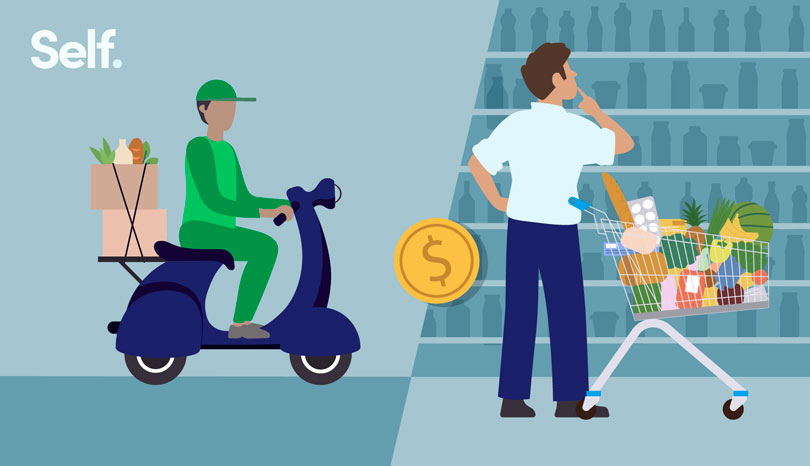

America is becoming increasingly time-poor, with psychologists using the term to describe the growing imbalance between the time people need and the time their work and daily responsibilities allow. [1] Newsweek, 'Americans Are Suffering From ‘Time Poverty’', 2025 https://www.newsweek.com/americans-suffering-time-poverty-2083948
As a result, many Americans are turning to convenience-driven services to make the most of their limited free time. Whether it's ordering takeout instead of cooking, subscribing to meal prep kits, or having groceries delivered through apps like Uber Eats, saving time where possible in everyday life has become a priority for many.
In fact, this shift in consumer behavior is already evident. A 2025 study found that 6.6% of Americans use Uber Eats to purchase groceries and household essentials. [2] YouGov, 'Exploring America’s Appetite for Food Delivery Apps', 2025 https://yougov.com/en-us/articles/51282-exploring-americas-appetite-for-food-delivery-apps
But just how much does that convenience cost?
New research conducted on behalf of Self Financial reveals the true price of time-saving grocery shopping by comparing the cost of ordering the same basket through Uber Eats with driving to a Target store and shopping in person.
The research relied on an existing list of an average grocery shop based on a 2024 report by Drive Research and compared the average price of three products when bought directly at Target versus when bought via Uber Eats. The study also included estimated gas costs associated with driving to the nearest available Target, which totaled $1.14. This was added onto the total basket price.
Key findings:
- Convenience is costing shoppers up to $1,735 per year by ordering groceries via Uber Eats rather than directly in-store.
- Overall, 93.1% of the products analyzed were cheaper when bought directly from Target, rather than via Uber Eats delivery.
- Cooking oil ($2.50), chicken breasts ($2.03), frozen pizza ($1.40) and instant oatmeal packets ($1.33) all offer the biggest price savings when shopping directly in store, rather than ordering via Uber Eats.
- Potatoes and orange juice were the only products more expensive when bought directly from Target, costing as much as $1.37 more.
- Cooking oil also has the greatest percentage price increase, with a 24.9% higher price when purchased through Uber Eats.
- This was followed by pasta (22.4%), instant oatmeal packets (21.8%), and pancake mix (21.5%), all of which were also more expensive when purchased via Uber Eats.
How much are Americans paying for convenience?
Overall, the research found that Americans are paying up to $33.37 more when ordering their grocery shopping via Uber Eats than shopping directly at Target, representing a 21.1% increase in the total cost of a typical grocery basket. The total basket cost when bought directly from Target cost $123.54, while ordering from Uber Eats cost $143.74.
Although notably higher when ordered via Uber Eats, this basket is still cheaper than grocery shopping in Alaska, which was found to be the most expensive state for groceries ($152.20) in previous research conducted on behalf of Self Financial.
On average, individual grocery items cost $4.77 on Uber Eats, compared with $4.10 when purchased directly from Target, highlighting that shoppers pay an additional $0.67 on average per item after delivery and service fees are applied. Previous research conducted on behalf of Self Financial found that Uber Eats is the second most expensive food delivery app, adding a 69.4% markup to the cost of a McDonald’s order.
A survey by Snipp in March 2025 found that 48% of respondents shopped for groceries once a week. [3] Snipp, 'How Inflation is Reshaping Grocery Shopping in 2025', 2025 https://www.snipp.com/hubfs/Snipp-Inflation-Grocery-Shopping-Shopper-Survey.pdf Based on this shopping frequency, choosing Uber Eats over shopping directly at Target could cost consumers an additional $145.15 per month, rising to $1,735.15 per year.
Convenience is costing shoppers up to $1,735.15 per year by ordering groceries via Uber Eats than directly at Target.
The greatest price difference was found in cooking oil, where shoppers paid $2.50 more when purchasing through Uber Eats than directly from Target. This was followed by chicken breasts ($2.03), frozen pizza ($1.40), and instant oatmeal packets ($1.33).
Cooking oil ($2.50), chicken breasts ($2.03), frozen pizza ($1.40) and instant oatmeal packets ($1.33) all offer the biggest price difference when shopping directly from Target rather than ordering via Uber Eats.
These findings suggest that the largest savings are often achieved on higher-priced grocery staples, with just a handful of items (such as cooking oil and chicken breasts) accounting for a significant proportion of the overall price difference between the two shopping methods.
The largest price premiums were also typically concentrated among pantry staples, including cooking oil, instant oatmeal and breakfast cereal. In comparison, fresh produce such as apples and carrots generally showed much smaller price differences, suggesting that shelf-stable grocery items often have higher price markups.
Of the 29 grocery items analyzed, 27 (93.1%) were cheaper when purchased directly from Target rather than through Uber Eats. This demonstrates that higher prices on Uber Eats were widespread across the shopping basket, rather than being limited to a small number of products, meaning the cost of convenience may be too high for some.
More than 93% of the products analyzed were cheaper when bought directly from the store, rather than via Uber Eats delivery.
Ordering groceries through Uber Eats is often more expensive because customers pay additional taxes, delivery charges, and service fees. In this study, these fees totaled $14.31 for a single order. Beyond these charges, individual grocery items were also subject to price markups. Previous reports have suggested these markups can reach as high as 12%. [4] Startup Daily, 'Why buying supermarket groceries on Uber Eats is god’s way of saying you have too much money', 2025 https://www.startupdaily.net/after-hours/life-hacks/why-buying-supermarket-groceries-on-uber-eats-is-gods-way-of-saying-you-have-too-much-money/ However, this analysis found that grocery items were priced on average, 14.1% higher on Uber Eats than at Target directly, indicating that the price premium extended beyond delivery-related fees alone.
| How much more expensive shopping via Uber Eats is | |
|---|---|
| Product | Price difference |
| Olive or vegetable oil | $2.50 |
| Chicken breasts | $2.03 |
| Frozen pizza | $1.40 |
| Instant oatmeal packets | $1.33 |
| Breakfast cereal | $1.07 |
| Croissants or pastries | $0.97 |
| Shampoo | $0.90 |
| Milk | $0.83 |
| Sandwich bread | $0.82 |
| Pancake mix | $0.80 |
| Crackers | $0.70 |
| Pasta (spaghetti or penne) | $0.70 |
| Cookies | $0.67 |
| Deli sliced ham or turkey | $0.67 |
| Eggs | $0.67 |
| Bottled water | $0.67 |
| Potato chips | $0.60 |
| Yogurt (Greek or regular) | $0.57 |
| Peanut butter | $0.57 |
| White or brown rice | $0.50 |
| Cheddar cheese | $0.38 |
| Salad kit | $0.37 |
| Butter | $0.33 |
| Apples | $0.33 |
| Frozen vegetables (e.g. broccoli, peas) | $0.27 |
| Carrots | $0.22 |
| Canned tomatoes | $0.20 |
| Potatoes | -$0.13 |
| Orange juice | -$1.37 |

On the other hand, two products proved to actually be more expensive when shopping directly at Target. Those were potatoes, which was $0.13 more expensive, and orange juice, which was $1.37 more expensive.
Potatoes and orange juice were more expensive when bought directly from Target, costing as much as $1.37 more.
| How much more expensive is shopping via Uber Eats? | |||
|---|---|---|---|
| Product | Average Uber Eats price | Average Target direct price | Price difference |
| Olive or vegetable oil | Average Uber Eats price $10.02 | Average Target direct price $7.52 | Price difference $2.50 |
| Chicken breasts | Average Uber Eats price $12.39 | Average Target direct price $10.36 | Price difference $2.03 |
| Frozen pizza | Average Uber Eats price $8.79 | Average Target direct price $7.39 | Price difference $1.40 |
| Instant oatmeal packets | Average Uber Eats price $6.12 | Average Target direct price $4.79 | Price difference $1.33 |
| Breakfast cereal | Average Uber Eats price $6.19 | Average Target direct price $5.12 | Price difference $1.07 |
| Croissants or pastries | Average Uber Eats price $5.72 | Average Target direct price $4.76 | Price difference $0.97 |
| Shampoo | Average Uber Eats price $6.56 | Average Target direct price $5.66 | Price difference $0.90 |
| Milk | Average Uber Eats price $5.62 | Average Target direct price $4.79 | Price difference $0.83 |
| Sandwich bread | Average Uber Eats price $4.86 | Average Target direct price $4.04 | Price difference $0.82 |
| Pancake mix | Average Uber Eats price $3.72 | Average Target direct price $2.92 | Price difference $0.80 |
| Crackers | Average Uber Eats price $3.72 | Average Target direct price $3.02 | Price difference $0.70 |
| Pasta (spaghetti or penne) | Average Uber Eats price $3.12 | Average Target direct price $2.42 | Price difference $0.70 |
| Cookies | Average Uber Eats price $4.12 | Average Target direct price $3.46 | Price difference $0.67 |
| Deli sliced ham or turkey | Average Uber Eats price $5.26 | Average Target direct price $4.59 | Price difference $0.67 |
| Eggs | Average Uber Eats price $4.12 | Average Target direct price $3.46 | Price difference $0.67 |
| Bottled water | Average Uber Eats price $3.69 | Average Target direct price $3.02 | Price difference $0.67 |
| Potato chips | Average Uber Eats price $3.86 | Average Target direct price $3.26 | Price difference $0.60 |
| Yogurt (Greek or regular) | Average Uber Eats price $3.32 | Average Target direct price $2.76 | Price difference $0.57 |
| Peanut butter | Average Uber Eats price $3.42 | Average Target direct price $2.86 | Price difference $0.57 |
| White or brown rice | Average Uber Eats price $2.96 | Average Target direct price $2.46 | Price difference $0.50 |
| Cheddar cheese | Average Uber Eats price $2.84 | Average Target direct price $2.47 | Price difference $0.38 |
| Salad kit | Average Uber Eats price $3.32 | Average Target direct price $2.96 | Price difference $0.37 |
| Butter | Average Uber Eats price $5.86 | Average Target direct price $5.52 | Price difference $0.33 |
| Apples | Average Uber Eats price $5.48 | Average Target direct price $5.16 | Price difference $0.33 |
| Frozen vegetables (e.g. broccoli, peas) | Average Uber Eats price $1.49 | Average Target direct price $1.22 | Price difference $0.27 |
| Carrots | Average Uber Eats price $1.77 | Average Target direct price $1.56 | Price difference $0.22 |
| Canned tomatoes | Average Uber Eats price $1.19 | Average Target direct price $0.99 | Price difference $0.20 |
| Potatoes | Average Uber Eats price $2.69 | Average Target direct price $2.82 | Price difference -$0.13 |
| Orange juice | Average Uber Eats price $6.72 | Average Target direct price $8.09 | Price difference -$1.37 |
Which grocery items have the biggest percentage price difference?
The study also examined which grocery items showed the largest percentage price difference when ordering via Uber Eats or shopping directly from Target. The results showed that cooking oil not only had the largest price difference, but it also had the largest percentage price difference. This product is 24.9% more expensive when purchased via Uber Eats.
This is followed by pasta (22.4%), instant oatmeal packets (21.8%) and pancake mix (21.5%).
On the other hand, previous research conducted on behalf of Self Financial found that eggs (78.7%) had the highest percentage markup when buying national brands vs Walmart’s private label, Great Value. This was followed by potato chips (73.4%), pasta (65.2%), and instant oatmeal packets (64%).
On average, in this study, shopping directly at Target rather than ordering via Uber Eats meant the entire basket was 21.1% cheaper overall.
| Percentage price difference: Uber Eats vs Target | |
|---|---|
| Product | Percentage price difference |
| Olive or vegetable oil | 24.9% |
| Pasta (spaghetti or penne) | 22.4% |
| Instant oatmeal packets | 21.8% |
| Pancake mix | 21.5% |
| Crackers | 18.8% |
| Bottled water | 18.1% |
| Frozen vegetables (e.g. broccoli, peas) | 17.9% |
| Breakfast cereal | 17.2% |
| Yogurt (Greek or regular) | 17.1% |
| White or brown rice | 16.9% |
| Croissants or pastries | 16.9% |
| Sandwich bread | 16.8% |
| Canned tomatoes | 16.8% |
| Peanut butter | 16.6% |
| Chicken breasts | 16.4% |
| Cookies | 16.2% |
| Eggs | 16.2% |
| Frozen pizza | 15.9% |
| Potato chips | 15.6% |
| Milk | 14.8% |
| Shampoo | 13.7% |
| Cheddar cheese | 13.2% |
| Deli sliced ham or turkey | 12.7% |
| Carrots | 12.2% |
| Salad kit | 11.0% |
| Apples | 6.0% |
| Butter | 5.7% |
| Potatoes | -5.0% |
| Orange juice | -20.3% |
However, not all grocery items attracted the same level of price premium. Fresh and refrigerated products, including butter (5.7%), apples (6%), salad kits (11%), carrots (12.2%), and deli sliced ham or turkey (12.7%), showed the smallest percentage differences between Uber Eats and Target.
Methodology
The products included in this study are representative of an average household grocery shop and are based on a 2024 report by Drive Research. Using this as a foundation, the study created a grocery basket of 30 commonly purchased items. The study removed products that did not have at least three comparable products. In this instance, bananas were the only product removed, leaving 29 products for analysis.
Pricing was collected using Target’s and Uber Eats websites in July 2026, set to a location in the most populated area of the United States (07731) to reflect pricing in a major consumer market. Discounts or promotions were not accounted for.
Delivery orders on Uber Eats include a series of one-time checkout costs. In this analysis, these consisted of sales tax ($2.12), a service fee ($3.70), and a delivery fee ($8.49).
For in-store purchases at Target, a nominal travel cost was incorporated to reflect the expense of driving to and from the store. This was estimated using average U.S. gasoline prices ($3.86 per gallon), an assumed round-trip distance of 3.8 miles, and an average vehicle fuel efficiency of 25.6 miles per gallon. Based on these inputs, the average driving cost per trip was calculated at $1.14, which was added to the in-store basket total to provide a more realistic comparison against delivery.
All prices were taken from live listings at the time of data collection.
Sources
- [1] Newsweek, 'Americans Are Suffering From ‘Time Poverty’', 2025 https://www.newsweek.com/americans-suffering-time-poverty-2083948
- [2] YouGov, 'Exploring America’s Appetite for Food Delivery Apps', 2025 https://yougov.com/en-us/articles/51282-exploring-americas-appetite-for-food-delivery-apps
- [3] Snipp, 'How Inflation is Reshaping Grocery Shopping in 2025', 2025 https://www.snipp.com/hubfs/Snipp-Inflation-Grocery-Shopping-Shopper-Survey.pdf
- [4] Startup Daily, 'Why buying supermarket groceries on Uber Eats is god’s way of saying you have too much money', 2025 https://www.startupdaily.net/after-hours/life-hacks/why-buying-supermarket-groceries-on-uber-eats-is-gods-way-of-saying-you-have-too-much-money/