Back to articles
Credit Bureau Basics: Experian, Equifax, TransUnion
When you apply for a loan, credit card, or even an apartment, there's a good chance a credit bureau is quietly doing the work behind the scenes.
Equifax, Experian, and TransUnion are the three major bureaus responsible for tracking your credit history and turning it into the reports and scores that lenders rely on to make decisions about you.
Key points
- Equifax, Experian, and TransUnion are the three major credit bureaus, and they collect, compile, and report your credit information to lenders.
- Bureaus get most of their data from furnishers, banks, credit card issuers, and other lenders who voluntarily report your account activity each month.
- Beyond lenders, your credit report can also be used by employers, landlords, and other organizations checking your financial risk or identity.
What is a credit bureau?
The three major credit bureaus in the United States are Equifax, Experian, and TransUnion. [1]
These companies are known as credit bureaus, credit reporting companies, or consumer reporting agencies, and they compile and sell credit reports. A credit bureau collects information about your borrowing and repayment history, including the original amount of a loan, your credit card balance and limit, whether you've paid on time, and any accounts sent to collections. This data comes from thousands of lenders across the country, as well as public records such as bankruptcies. [2]
Credit bureaus don't decide whether you get approved for a loan or credit card. Lenders use credit reports the bureaus compile to make that decision themselves, including what interest rate to offer. [3]
The Fair Credit Reporting Act (FCRA) is the federal law that governs how credit bureaus operate, including how they can disclose your information and who is allowed to request it. [2]
How do credit bureaus get your information?
Most of the information in your credit report comes from other companies called data furnishers, the same financial institutions you regularly interact with, including:
- Banks
- Credit unions
- Credit card issuers
- Mortgage lenders
- Loan servicers
- Collection agencies
Furnishers send information about your accounts, such as when you opened an account, its current balance, and whether you paid on time, generally updating the bureaus every month. Companies also report information from your credit applications, which is part of why your report may include your current and past names, addresses, phone numbers, and employers.
Furnishers aren't required to report to the bureaus. It's entirely voluntary, though doing so allows them to report late payments, which gives borrowers an incentive to pay on time. [4]
Why are there three major credit bureaus?
With the three major credit bureaus being Equifax, Experian, and TransUnion, each one is independently responsible for collecting and compiling your credit information and reporting it to lenders. [2] Because each bureau operates its own database, the exact details in your file, and your score, can vary depending on which one a lender checks. [5]
These three companies didn't start out as a fixed national system. Credit bureaus first emerged in the U.S. in the late 1800s to support merchant lenders extending credit to local businesses and individuals, and for decades, most communities had their own local credit bureau. By the early 1970s, the industry comprised more than 2,250 of these local and regional firms. As the decade progressed and computer databases made nationwide coverage possible, the industry consolidated, and most local bureaus sold their records to what became the major national bureaus we know today. [6]
Experian vs Equifax vs TransUnion
Equifax, Experian, and TransUnion all do fundamentally the same job. Each collects, compiles, and reports the same broad categories of information: your borrowing and repayment history, account balances, payment status, and public records like bankruptcies, and each is bound by the same federal law, the FCRA, governing how that information can be used and disclosed. [2]
You don't get a say in whether this happens. Creditors report to credit reporting companies voluntarily, and you cannot opt out of having your accounts reported. If you spot an error, you can dispute it, but you can't stop reporting from happening in the first place. [7]
Lenders, on the other hand, do get a choice. They can choose to report your account activity to one, two, or all three bureaus, and they aren't required to update each one on the same schedule. [5] That's part of why your file, and your score, can look different depending on which bureau a lender checks.
What information is collected?
Beyond what furnishers report, credit bureaus also collect public records data, such as bankruptcy filings. Tax liens and civil judgments used to appear on credit reports too, but the bureaus no longer include them.
Even when it's available, credit bureaus don't include everything about you. For example, your credit report won't include:
- Race
- Ethnicity
- Religion
- Marital status
- Medical history
- Sexual orientation
- Political affiliations
- Friends
- Criminal records
Your credit reports also don't contain information about your income, bank account, or investment account balances. [4]
Who uses credit reports?
Credit bureaus create and sell credit reports, but they aren't the ones making decisions based on them. A range of organizations purchase credit report data to better understand the financial risk associated with an individual, and each uses it differently. [4]
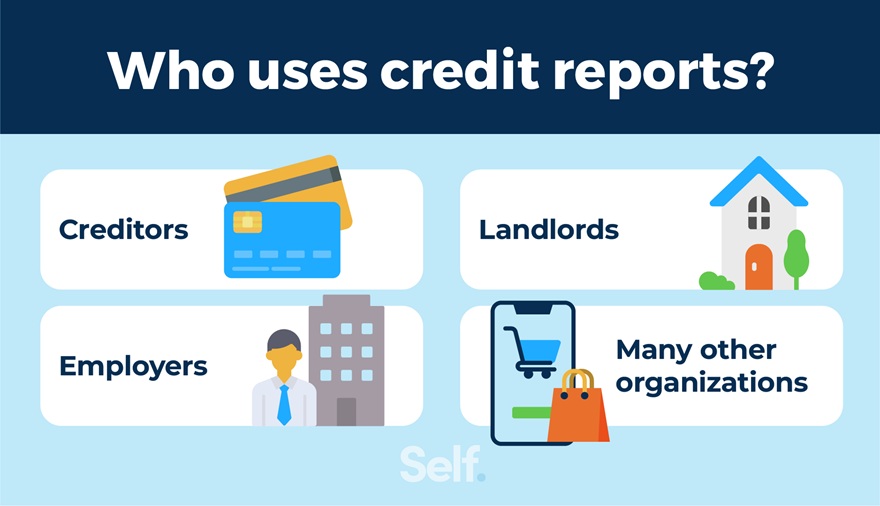
Creditors
Creditors, such as lenders and credit card issuers, use credit reports and credit data in several ways. They may work with a bureau to build a list of consumers who meet certain criteria and send those consumers preapproved offers. When someone applies for credit, the creditor typically uses a credit report and score to decide whether to approve the application and what terms to offer. Creditors also regularly pull reports and scores to monitor existing accounts, which can lead to a closed account, a card upgrade, or a changed credit limit. [4]
Employers
In some states, employers can use credit checks when hiring or promoting someone, most commonly in the financial sector or for roles requiring security clearance. Employers never receive a credit score alongside the report, and the version of the report they see is different from what a lender gets; it doesn't include your date of birth or account numbers. [4]
Landlords
Landlords may also use a credit report and score when reviewing rental applications. Someone with a poor credit history could have more trouble qualifying for a rental, or may be asked to pay a larger security deposit. [4]
Many other organizations
Almost any company that needs to verify a user's identity, including financial institutions, casinos, and online marketplaces, may use data from the credit bureaus. These companies don't receive a full credit report, but they can check whether the identifying information someone provides matches what's in a bureau's database. A mismatch in name, address, or date of birth can be a sign of identity fraud. [4]
Frequently asked questions
Which credit bureau is the most important?
No credit bureau is considered more important than the others. Since credit reports can differ based on the activity each bureau receives, those differences can lead to slight variations in your credit score depending on which bureau a lender checks. [8]
How do I freeze my credit at all three bureaus?
You have the right to freeze and unfreeze your credit for free at Equifax, Experian, and TransUnion. A freeze must be placed within one business day of receipt of your request if made online or by phone, or within three business days if made by mail. Freezing your credit with one bureau doesn't notify the other two, so you'll need to contact each bureau individually if you want to freeze your file across all three. [9]
Are there other types of credit bureaus besides the big three?
Beyond Equifax, Experian, and TransUnion, there are smaller specialty consumer reporting companies that collect information and produce reports for specific industries like retail, medical, telecom, and housing. [8]
How do I get a copy of my credit report?
You can request a free copy of your credit report from each of the three bureaus at AnnualCreditReport.com, the only site authorized to fill these requests under federal law. All three bureaus have permanently extended a program that lets you check your report from each of them once a week at no cost, and federal law separately guarantees a free copy from each bureau at least once every 12 months even outside that program.
Sources
- U.S. Bankruptcy Court, Western District of Louisiana. "What are the three major credit reporting agencies?" https://www.lawb.uscourts.gov/content/what-are-three-major-credit-reporting-agencies. Accessed July 22, 2026.
- Consumer Financial Protection Bureau. "What is a credit reporting company?" https://www.consumerfinance.gov/ask-cfpb/what-is-a-credit-reporting-company-en-1251/. Accessed July 22, 2026.
- Consumer Financial Protection Bureau. "What is a credit report?" https://www.consumerfinance.gov/ask-cfpb/what-is-a-credit-report-en-309/. Accessed July 22, 2026.
- Experian. "What Are Credit Bureaus and How Do They Work?" https://www.experian.com/blogs/ask-experian/what-is-a-credit-bureau/. Accessed July 22, 2026.
- TransUnion. "Credit Reporting Agencies." https://www.transunion.com/credit-reporting-agencies. Accessed July 22, 2026.
- Consumer Financial Protection Bureau. "Key Dimensions and Processes in the U.S. Credit Reporting System." https://files.consumerfinance.gov/f/201212_cfpb_credit-reporting-white-paper.pdf. Accessed July 22, 2026.
- Consumer Financial Protection Bureau. "Can I opt out of having creditors report my accounts to credit reporting companies?" https://www.consumerfinance.gov/ask-cfpb/i-do-not-want-creditors-to-report-my-accounts-to-credit-reporting-companies-what-can-i-do-en-1257/. Accessed July 22, 2026.
- Capital One. "What Are the 3 Credit Bureaus?" https://www.capitalone.com/learn-grow/money-management/three-credit-bureaus/. Accessed July 22, 2026.
- Consumer Financial Protection Bureau. "What is a credit freeze or security freeze on my credit report?" https://www.consumerfinance.gov/ask-cfpb/what-is-a-credit-freeze-or-security-freeze-on-my-credit-report-en-1341/. Accessed July 22, 2026.
About the author
Becca has over 10 years of experience as a content writer, working across various industries including finance, digital marketing, education, travel, and technology. Her work has been featured in publications including Forbes, Business Insider, AOL, Yahoo, GOBankingRates, and more.