Back to articles
How to Refinance a Car Loan
Refinancing a car loan may make sense for some borrowers, especially when finding better interest rates or agreeing to terms with a better credit rating than when you agreed to your original car loan.
But before proceeding, it’s important to consider these steps. This includes checking your credit, shopping around, and finding the right auto loan for you. In this article, we look at when and when not to refinance your auto loan, and provide a step-by-step guide on how to refinance your car loan.
Key findings
- Refinancing replaces your existing car loan with a new one and can make sense if your credit has improved, interest rates have dropped, or you need to reduce your monthly payments.
- It is not always the right move, particularly if your car is over 10 years old, you owe more than the vehicle is worth, or your current loan carries a prepayment penalty.
- The process involves assessing your current loan, checking your credit, comparing lenders, gathering documents and finalizing a new loan to pay off the old one.
What does it mean to refinance a car loan?
Refinancing your car means a new auto loan will replace your existing one. If approved, the new loan pays off your current one, and your new one takes its place. You will begin making monthly payments on the new loan.
The application may not take long, and it could save you money by lowering your monthly payments or reducing the interest you pay if you’re approved for a lower interest rate. [1]
But before you apply, there are some things to take into account.
When should you refinance a car loan?
There may be benefits to refinancing your auto loan, including saving on monthly payments and securing lower interest rates.
Your credit score has increased
Credit scores are among the main factors lenders use to determine whether a loan is approved. Refinancing can be advantageous when you have a higher credit score than when you first financed your car. A better credit score may help you land lower interest rates or even reduce monthly payments. [1]
Interest rates have dropped
If interest rates have gone down since you took out your original loan, then refinancing could save you money. Lower interest rates mean you will pay less in interest over the life of the loan and could reduce your monthly payments; even a small rate decrease could make a significant difference. [2] A decrease in interest of just 2-3% could save you hundreds overall if you don’t extend the term. [1]
You want cheaper monthly payments
A lower interest rate will often reduce your monthly payment, but it may not be the only lever available to you. When you refinance, you may also be able to extend your repayment term, spreading the remaining balance over a longer period and reducing your monthly payment.
The trade-off is that a longer term means more interest paid over the life of the loan. But if your budget is tight and keeping up with payments is a genuine concern, that trade-off can be worth making. [2]
When you shouldn’t refinance
Refinancing isn't the right move for everyone. Before you apply, it's worth checking whether any of these situations apply to you.
Your loan has a prepayment penalty
Some lenders charge a fee for paying off your loan ahead of schedule, which is exactly what refinancing does. This penalty is typically around 2% of your remaining balance. If your current loan includes one, run the numbers carefully before proceeding. The fee may cancel out whatever you'd save with a lower rate. [2]
Your car is more than 10 years old
Older vehicles can make refinancing difficult. If your car is 10 years old or older, or has more than 100,000 miles on the clock, many lenders simply will not refinance it. In that situation, your energy is likely better spent paying down the existing loan. [2]
You owe more than the car is worth
If your loan balance exceeds your vehicle's current market value, you have negative equity. Most lenders will not approve a refinance in this scenario, and those that do may require you to pay the difference to your original lender upfront before the new loan can be completed. [2]
Your credit score has not improved
If your credit score is the same as when you took out the original loan, or has dropped since then, securing a lower interest rate becomes much harder. Refinancing under these conditions could result in equal or worse terms than what you already have. [2]
What credit score do you need to refinance?
There’s no minimum credit score required to refinance an auto loan. But generally, a higher credit score will give you a better chance of approval. [3] Credit score requirements vary by lender, but as a general benchmark, FICO classifies 670–739 as a good credit score, [4] while VantageScore considers a similar range of 661–780 to be "prime." [5]
How to refinance a car loan: step-by-step
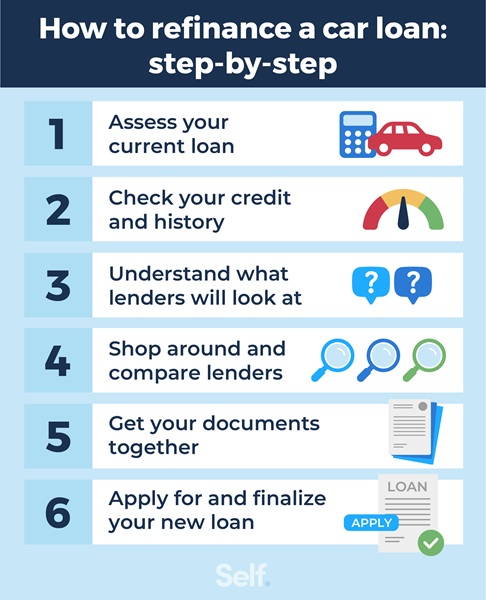
1. Assess your current loan
Before doing anything else, get a clear picture of where you stand. TransUnion recommends reviewing four key things about your existing loan:
- Monthly payment and interest rate: If these seem high compared with what may be available now, refinancing could be worth exploring.
- Remaining balance and time left: The more balance and time left on your loan, the more a lower rate has to work with.
- Vehicle age and mileage: Most lenders will not refinance a car that is more than 10 years old or has more than 100,000 miles on the clock.
- Loan-to-value ratio: Your loan-to-value ratio will be considered during the application. If you owe more than the car is worth, many lenders will decline the application outright.
[3]
2. Check your credit and history
Before you apply, it is worth taking stock of where your credit stands. Your credit score helps lenders decide whether to approve your application and what interest rate to offer you, so knowing your position ahead of time matters. [3]
You can access your credit report for free once a week from each of the three bureaus through AnnualCreditReport.com. This gives you your full credit report, not your credit score. For your score, check directly with your bank, credit card provider or one of the bureaus.
If your score has improved since you took out your original loan, you may be in a stronger position to secure better terms. If it has dropped, it is worth understanding that before you apply, as it could affect what lenders are willing to offer.
3. Understand what lenders will look at
No two lenders evaluate applications in exactly the same way, but according to the CFPB, there are several factors that auto lenders generally consider when deciding what rate and terms to offer a borrower:
- Your credit score and credit history
- Your income and existing debts
- The size of the loan
- The length of the loan term
- Your down payment relative to the vehicle's value, known as the loan-to-value ratio
- Whether the vehicle is new or used
[6]
4. Shop around and compare lenders
When refinancing, finding the most competitive rate and terms means approaching multiple lenders. Banks, credit unions and online lenders can all offer refinancing, and the differences between them can be significant, so collecting multiple quotes before committing is worthwhile. As you compare, focus on three things: the interest rate, the loan term, and any fees involved. [3]
The Consumer Financial Protection Bureau recommends getting prequalified or preapproved with several lenders before making a decision, as this gives you a clearer picture of what you actually qualify for rather than what is simply advertised. While their guidance covers auto loan shopping broadly, the same principles apply when refinancing since you are effectively shopping for a new loan to replace your existing one.
One practical point worth keeping in mind is that each application can trigger a credit check, so try to keep all your rate shopping within a window of 14 to 45 days, as most credit scoring models will treat multiple inquiries made in that period as a single one. [7]
5. Get your documents together
Before you apply, it is worth gathering everything a lender is likely to ask for so the process moves smoothly. Most lenders will require the following:
- Proof of income
- Proof of residence
- Proof of insurance
- Vehicle details, including VIN and current payoff amount
- A clean title in your name
[8]
6. Apply for and finalize your new loan
With your chosen lender and documents ready, you can submit your application online or in person. The lender will review your application and inform you of their decision, which often occurs within a day.
Timelines vary by lender, but to give a sense of what to expect, Chase notes that after approval, it typically takes about 2 weeks to complete the required documentation, followed by an additional 30 to 60 days to pay off your existing loan and update the title, depending on your state's DMV.
Once everything is processed, your new loan begins and you will receive payment information from your new lender. Keep making payments on your existing loan throughout this period until you have confirmed the refinance is fully complete. [9]
FAQs
Does refinancing a car loan hurt your credit?
Refinancing will likely cause a temporary dip in your credit score due to a credit check from the lender. Accepting a loan offer typically results in a further small drop. [10]
How much can you save when refinancing?
Savings vary depending on your rate, remaining balance and new loan terms. According to Experian's State of the Automotive Finance Market report, borrowers who refinanced in Q2 2025 saw their average interest rate fall from 10.45% to 8.45%, reducing their average monthly payment by $71. [11] This gives a sense of the impact a lower interest rate can have, and what a borrower might typically expect when refinancing at a more favorable rate.
Are there fees to watch out for?
Some lenders charge a prepayment penalty for paying off your existing loan early, which is what refinancing does. Experian notes this is typically around 2% of your outstanding balance. It is worth checking whether your current loan includes one and factoring that cost into any potential savings before proceeding. [2]
Sources
- Chase. "Guide to Refinancing a Car Loan: How it Works." https://www.chase.com/personal/auto/education/financing/guide-to-refinancing-a-car-how-it-works. Accessed May 6, 2026.
- Experian. "Auto Loan Refinancing: Options and Rates." https://www.experian.com/blogs/ask-experian/auto-loan-refinancing/. Accessed May 6, 2026.
- TransUnion. "How to Refinance a Car Loan: A 6-Step Guide." https://www.transunion.com/blog/car-buying-tips/how-to-refinance-a-car-loan. Accessed May 6, 2026.
- myFICO. "Credit Scores." https://www.myfico.com/credit-education/credit-scores. Accessed May 6, 2026.
- VantageScore. "The Complete Guide to Your VantageScore." https://vantagescore.com/consumers/blog/the-complete-guide-to-your-vantagescore. Accessed May 6, 2026.
- Consumer Financial Protection Bureau. "How Does a Lender Decide What Interest Rate to Offer Me on an Auto Loan?" https://www.consumerfinance.gov/ask-cfpb/how-does-a-lender-decide-what-interest-rate-to-offer-me-on-an-auto-loan-en-765/. Accessed May 6, 2026.
- Consumer Financial Protection Bureau. "What Should I Know Before I Shop for a Car or Auto Loan?" https://www.consumerfinance.gov/ask-cfpb/what-should-i-know-before-i-shop-for-auto-loan-at-a-bank-credit-union-dealership-or-other-lender-en-755/. Accessed May 6, 2026.
- Car and Driver. "What Do You Need to Refinance Your Car?" https://www.caranddriver.com/auto-loans/a43149178/how-to-refinance-a-car/. Accessed May 6, 2026.
- Chase. "Auto Loan Refinancing." https://autofinance.chase.com/auto-finance/refinance. Accessed May 6, 2026.
- PNC. “The Pros and Cons of Refinancing Your Car,” https://www.pnc.com/insights/personal-finance/borrow/pros-and-cons-of-refinancing-car.html. Accessed on May 13, 2026.
- Experian. "Why More Borrowers Are Refinancing Their Vehicles, and How Lenders Are Playing a Role in These Changes." https://www.experian.com/blogs/insights/auto-why-more-borrowers-are-refinancing-their-vehicles-and-how-lenders-are-playing-a-role-in-these-changes/. Accessed May 6, 2026.
About the author
Becca has over 10 years of experience as a content writer, working across various industries including finance, digital marketing, education, travel, and technology. Her work has been featured in publications including Forbes, Business Insider, AOL, Yahoo, GOBankingRates, and more.